
How to Inspect a Renovated Bathroom — Look Past the Tiles
A bathroom can look finished weeks before it is fit to accept. New tiles, fresh paint and good lighting say nothing about drainage falls, pipe joints, waterproofing or whether anyone can ever reach the bath trap again.
A Bathroom Is a System, Not a Finished Room
A normal walk-through finds scratched tiles, poor silicone and misaligned fixtures. Bathroom snagging asks a harder question: does the room actually work when water is running through it?
Water supply, drainage, waterproofing, ventilation, electrical services, sanitaryware and finishes all operate together in a space of a few square metres. If one of those is installed badly, the failure shows up in the others — usually months later, and usually behind something expensive.
That is why the inspection runs water rather than looking at taps. Falls are checked by watching where water travels, not by studying the tile pattern. Drains are tested one at a time and then together. Vanity interiors are checked after the basin has been running, because a connection that looks dry at first often starts weeping after several minutes.
Everything that matters most — membrane, pipe joints, pipe routes, condensate lines — is visible for a few days during the works and never again. Inspecting during those days is the difference between an adjustment and a demolition.
Where Renovated Bathrooms Actually Fail
Six defect groups account for most of what we record — and none of them is visible on handover day.
Concealed Pipework
Substituted materials, poorly fused PPR joints, unsupported runs and reversed hot and cold — all sealed into the wall before anyone checks a brand or a marking.
Untested Supply Lines
Pressure testing skipped to hold a programme date. The same weeping joint costs a morning before tiling and a demolition afterwards.
Drainage Falls
Waste runs laid flat or backfalling hold water and sediment. The symptoms — slow drainage, gurgling, odour, repeat blockages — get blamed on everything except the slope.
Floor & Shower Levels
Drains set too high, screed low spots, showers falling towards the door. Correcting it means lifting tiles, so it has to be caught at tiling stage.
Waterproofing Details
Membranes fail at corners, junctions, drains and pipe penetrations — never in the middle of a floor. Once tiled, none of it can be verified directly.
No Maintenance Access
Baths tiled in solid, panels that reach nothing, valves buried behind finishes. A minor leak then becomes a demolition job.
What a Bathroom Inspection Covers
Visual checks combined with functional testing — water run through every fixture, then everything rechecked once it has been running.
Water Supply
- Pipe type against specification
- Joint quality & pipe supports
- Pressure test records
- Isolation valves & accessibility
- Hot / cold orientation at every outlet
- Pressure at each outlet, then combined
- Leaks once lines reach temperature
Drainage & Levels
- Basin, shower, bath & WC tested separately
- Fixtures run together under load
- Floor drain flow & drain level
- Controlled water-flow test for falls
- Ponding & local low spots
- Water escaping past the screen
- Traps, waste connections & odour
Waterproofing & Moisture
- Membrane continuity where accessible
- Corners, junctions & thresholds
- Pipe penetration detailing
- Drain interface & niches
- Flood test before tiling
- Moisture readings at wet junctions
- Thermal scan of suspect areas
Fixtures & Joinery
- WC stability, flush & continuous filling
- Concealed cistern & flush-plate access
- Bath stability & waste operation
- Shower screen, seals & door operation
- Vanity interior checked under flow
- Cabinet base, edges & swelling
- Mirrors & accessories, sealed where drilled
Ceiling, MEP & Air
- AC condensate routing & fall
- Access panels — position and reach
- Ceiling staining & level
- Light fittings suitable for wet areas
- Neat cut-outs, no exposed wiring
- Switches, sockets & accessories
- Exhaust operation, airflow & duct route
Finishes & Hygiene
- Tile lippage under side lighting
- Hollow tiles sounded throughout
- Joints, cuts & corner finishing
- Grout & movement-joint detailing
- Sealant at every wet junction
- Cleanability — gaps & dirt traps
- Work compared against BOQ & samples
Bathroom Inspection in 4 Steps
Send the Details
Property type, bathroom count, renovation stage and any BOQ or drawings you have, for a fixed quote.
Book the Right Stage
Before tiling if the works are live; after cleaning if the renovation is finished. Water and power must be connected.
Test, Don’t Just Look
Every fixture run, falls checked with water, moisture mapped, concealed areas photographed.
Report in 6 Hours
Numbered findings with photos, ready to hand to your contractor before the final payment.
One Final Visit Is Never Enough
By handover, the most important work is already covered. For a full bathroom renovation, these are the moments worth inspecting.
1. Plumbing Rough-In
- Pipe material & markings verified
- Joints, fusion quality & supports
- Routing & drainage falls
- Valve positions
- Pressure testing before closure
2. Waterproofing
- Substrate preparation
- Corners & wall-floor junctions
- Penetrations & drain interface
- Coverage & coats
- Flood test, photographed
3. Before Ceiling Closure
- Concealed plumbing above the ceiling
- AC condensate route and fall
- Electrical & exhaust ducting
- Supports & fixings
- Access panel positions agreed
4. Tiling & Levels
- Falls to the floor drain
- Shower area slope
- Drain level against finished tile
- Lippage & alignment
- Joints & grout
5. Final Functional Test
- Every fixture operated
- Drainage & ponding observed
- Vanity, ceiling & walls rechecked
- Ventilation & electrical checked
- Sealant, finishes & accessories
6. De-Snagging
- Reported items re-checked on site
- Rectification verified, not assumed
- New damage from repairs recorded
- Findings closed item by item
- Report reissued for final payment
Signs a Bathroom Renovation Went Wrong
If any of these appeared after the work, the symptom should be traced rather than repeatedly repaired.
Odour That Returns
Cleaning removes the smell, not its route. A recurring drain smell usually means a broken water seal — a missing, dry or badly fitted trap, or an unsealed waste connection.
Water That Stays
Persistent puddles, water travelling away from the drain, or water reaching the door. Surface-tension droplets are normal; standing water is a levelling defect.
Mould After Treatment
Returning growth points at concealed moisture, condensation or an extract that moves too little air — three different causes with three different repairs.
Stains Below
A mark on the ceiling underneath, or damp on the far side of a wet wall. Investigate before more finishes go on top of it.
Swollen Joinery
A vanity base or skirting swelling means water is sitting where it should never be — usually a slow leak inside the cabinet or a floor that drains the wrong way.
The Same Repair Twice
If an item has been fixed more than once, the earlier repairs were diagnoses — and both were wrong. New sealant will not solve a failed membrane.
Findings Your Contractor Can Actually Work Through
Every item is numbered, photographed and located, and separated into technical defects and cosmetic ones — so leakage, falls and waterproofing concerns sit above paint touch-ups rather than buried among them.
Download a sample below to see the structure your bathroom report will follow.
Every Report Includes
- Photo & video evidence for every defect
- Exact location tagging, area by area
- Technical defects separated from cosmetic
- Severity rating — critical issues first
- Delivered digitally within 6 hours
Bathroom Snagging Questions, Answered
When is the best time to inspect a bathroom renovation?
Before tiling is the single most valuable visit, because waterproofing, pipe joints and drainage falls are all visible then and never again. A final inspection after cleaning catches everything else. On a full renovation, both are worth doing.
Can you inspect a bathroom that is already finished?
Yes. A finished bathroom is tested functionally — every fixture run, falls checked with water, moisture readings taken, ventilation and access assessed. What cannot be done is direct verification of work already sealed behind tiles.
Are PPR pipes good for bathroom plumbing?
PPR is widely used for hot and cold supply and performs well when the material, fittings and fusion process follow the system requirements. The brand alone means little — overheated joints restrict the bore, underheated ones weep months later, and unsupported runs stress the weakest connection.
Why does my new bathroom smell?
Almost always a broken water seal rather than a dirty bathroom: a missing, dry or wrongly installed trap, an unsealed waste or floor-drain connection, an incorrectly connected AC condensate line, or standing water in a flat waste run.
Water stays on the floor after every shower. Is that normal?
A few droplets holding by surface tension are normal. Persistent puddles, water moving away from the drain or water reaching the door indicate insufficient fall, a drain set too high, or low spots in the screed — corrections that usually mean lifting tiles.
Can waterproofing be checked after tiling?
Not directly. Once covered it can only be assessed by behaviour — where and when moisture appears, how the area responds to controlled water testing, and what the readings show at junctions. That is why the flood test belongs before tiling.
Is a hollow-sounding tile a defect?
Not on its own. Hollow sounds occur in sound installations too. Widespread or significant hollow areas can indicate poor adhesive coverage or a substrate issue, and are recorded for assessment rather than dismissed.
Can thermal imaging find a hidden bathroom leak?
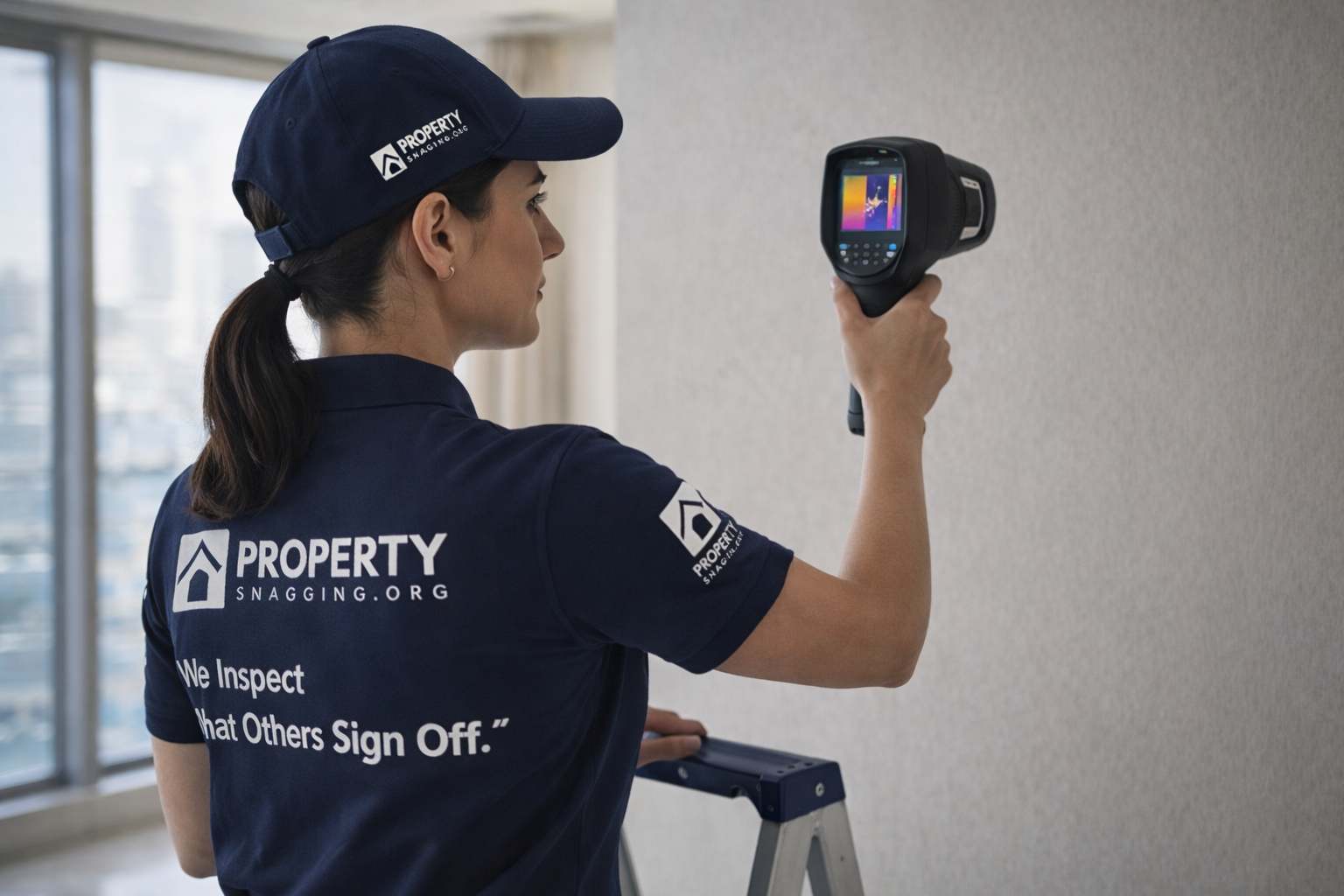
It identifies temperature anomalies that show where to investigate, but it does not see water inside a wall. Anomalies can also come from AC, sun exposure or different materials, so thermal findings are read alongside moisture readings and water testing. Thermal imaging & moisture inspection
Should I pay the contractor before snagging?
Follow your contract, but the controlled sequence is completion, snagging, rectification, de-snagging, then final payment. Once the full amount is paid, small defects become noticeably harder to get corrected.
How much does a bathroom inspection cost?
It depends on the number of bathrooms and whether you want a single final inspection or stage visits during the works. You always receive a fixed written quote before booking.
Do you carry out the repairs you find?
No. We inspect only, and quote for none of the remedial work — which is what keeps the report independent of whoever would be paid to fix it.
Tiles Hide Everything. We Run the Water.
Send your property type and renovation stage — we’ll test the plumbing, drainage, falls and finishes, and hand you a numbered report before the final payment leaves your account.
Request Your Quotation